To those of a certain age the name Roll Air brings to mind soft summer nights watching the lights glow in the summer dusk, large crowds, laughter, and the feel of rock and roll vibrating across the roller rink as the Battle of the Bands became the heartbeat of the venue and Roll Air was transformed into a mecca for teens in mid-Michigan.
The story of the Roll Air Rink began in 1948 when Sylvan and Effie McQuillan purchased a parcel of land just west of Bay City State Park and constructed Putt Tee, the area’s first miniature golf course. 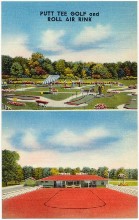 Putt Tee/Roll Air postcard
Although new to Bay City, miniature golf courses made of artificial materials first began to emerge during the early 20th century. By the late 1920s there were over 150 rooftop courses in New York City alone and tens of thousands across the United States. The American miniature golf boom of early 20th century came to an end during the Great Depression, and nearly all courses in the United States were closed and demolished before the end of the 1930s.
Sylvan (S. E.) McQuillan grew up on his family’s farm in Howell, Michigan. McQuillan was employed as a municipal court clerk, and his wife Effie was a registered nurse when they first opened a miniature golf facility in Howell in the 1930s; but the poor economic conditions forced it to close after only one year.
Despite taking a serious financial hit, the idea of running a miniature golf course had not lost its appeal for the McQuillan’s. Over the next ten years, the couple traveled around the United States and studied successful sites, including courses in Michigan at Houghton Lake and Benton Harbor, before deciding to buy a parcel of land located near the corner of Euclid and State Park Drive in 1948.
The location was ideal, situated just west of Bay City State Park, a popular destination for swimming, picnicking and camping during the summer months. It was also just across the street from Tony’s Amusement Park.
Tony’s Park was founded in 1942 by Anthony Giffel, a resident of Essexville. Giffel was the owner of a vending machine company, and he kept the park’s arcade stocked with shooting games, pinball machines, and fortune-telling attractions. 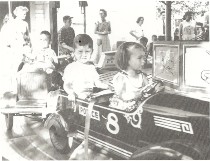 Children at Tony's Park
Although the arcade appealed to older kids, the rides and other features at Tony’s Park were targeted at those 10 and under. Among the children's rides, the unquestioned highlights were the carousel and the miniature train that ran on a set of steel tracks, complete with a long wooden tunnel located at the rear of the park. There was also an animal house that featured bears, raccoons, and porcupines along with the ever-popular monkey house.
The miniature golf course opened for business during the summer of 1949, and it was Effie McQuillan who named it ‘Putt Tee’. Some of the first ads in the Bay City Times contained little rhymes like this one from June 25, 1949: “Doctor, lawyer, merchant, chief, shopman clerk…it’s our belief. A bit of fun is good for all. Play Putt Tee Golf from spring to fall.”
On May 10, 1950, S. E. McQuillan debuted his Straight From The Shoulder ads in the Bay City Times. Designed to resemble a regular newspaper column, the ads featured a photo of the back of McQuillan's head and used folksy humor to promote Putt Tee and highlight its unusual putting surface. The miniature golf course used painted sand, ground into fine particles in a cement mixer, painted green, spread over an asphalt base, and swept into place.
Other ads that summer described the Putt Tee tournaments held at the course for mixed twosomes, as well as those with local service organizations like the Bay City Exchange Club. The ads also praised Putt Tee’s neighboring businesses including Tony’s Park, the Log Cabin bar, the Harbor Lights restaurant, and Walker’s Shell Service Station.
McQuillan’s Straight From The Shoulder ad on June 6, 1951, mentioned the construction of an open-air roller rink adjacent to Putt Tee and a contest to name the new facility with a $25 prize for the winning entry. 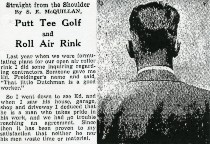 Straight From The Shoulder ad from 1951
Two weeks later, it was revealed that ‘Roll Air Rink,’ submitted by Mrs. Eldon La Flamme, was selected as the winning entry and recipient of the $25 prize. S. E. McQuillan went on to state, “If the rink should develop into a successful business, the name Roll Air will more than pay for itself.”
The July 11th ad mentioned that Roll Air was about to open, and stated that dress was casual, but no bathing suits were allowed in the rink. It included the hours that the rink would be open and the rates for skating – 30 cents for 14 and under, and 60 cents for older skaters.
During July of 1958, the combination of dancing and skating was introduced at Roll Air. The Straight From The Shoulder ads revealed that DJ John “Old Dad” Hagerman from WWBC-AM’s Pix ‘til Six show was spinning the discs. There was a 50 cents admission for those who wished to skate and dance. There was a lesser charge of 25 cents for those who arrived at 9:30 PM or later just to dance.
The Saturday night skating/dancing events had a dress code – jeans and tee shirts were not considered proper attire. In addition, no pass-out checks were to be issued, and no one could re-enter after leaving the rink. It was also the first time that rock and roll music at Roll Air appeared in print. McQuillan called the dances “Rock and Roll Air Sessions,” and he even mentioned viewing American Bandstand while inviting to the rink any folks who just wanted to watch the young people dance.
The investment ten years earlier had paid off. The couple lived in a nearby trailer park during the summers and spent their winters in Florida. Although S. E. McQuillan remained enthusiastic about both businesses, he and his wife were apparently ready to retire. Straight From The Shoulder’s August 28, 1958, ad mentioned for the first time in print that Roll Air and Putt Tee were for sale.
S. E. and Effie rejected several offers before listing the property in the Bay City Times for the first time on August 6, 1960, indicating that they would finance the sale. No sale was completed, however, and the couple continued to run the popular summertime attractions on State Park Drive for the next three years. 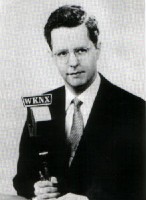 Bob Dyer
WKNX-AM DJ Bob Dyer made his debut spinning the discs at Roll Air’s weekly dance on July 18, 1962. It was noteworthy because Dyer would become an important person in helping establish the Battle of the Bands at Roll Air two years later during the summer of 1964.
During the summer of 1963, Roll Air introduced live entertainment by combining folk music performances with the weekly dances. These ‘Hootenanny and Record Hops’ featured folk groups from colleges and cities around the state including The Townsmen from Western Michigan University, The Gatemen and The Burgundy Trio from Michigan State University, The Merry Men from Cadillac, The Medallions from Saginaw, and The Newports from Bay City.
On August 13, 1963, singer and television personality Kenny Roberts, known as the “Jumping Cowboy,” was the headliner. Roberts had performed in a country band with Bill Haley during the 1940s, and he taught the future rock and roll star some of his yodels. Roberts started hosting a daily show on WNEM-TV in Saginaw in 1961 that featured him playing guitar, yodeling, jumping, and singing as he hosted children in the studio and presented cartoons. He was best known in Michigan for performing his local hit, “Cheer Up, (Things Could Be Worse).”
Despite an article in the Bay City Times that included a photo of The Merry Men and a caption that declared that folk music had “replaced rock and roll and the twist,” the popularity of folk music had begun to die out around the country; and the arrival of The Beatles at the start of 1964 was the final nail in the coffin. The attendance at the hootenanny/dances was low as area teens were looking for something a little more exciting.
Roll Air and Putt Tee closed for the season on September 8, 1963. Sadly S. E. McQuillan passed away unexpectedly, at the age of 59, from a heart attack at his home on October 4, 1963. Following her husband’s passing, Effie listed the property with Schmidt Realty on Salzburg in Bay City. 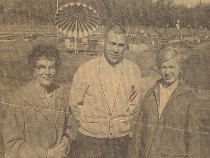 Effie McQuillan, Bob and Ilene Darbee
The Roll Air/Putt Tee complex was sold to four Bay City public school educators, Bob and Ilene Darbee and Octavian and Christine Gavrila. Their ownership was formally introduced in the May 15, 1964, issue of the Bay City Times that featured a photo of Effie McQuillan with Bob and Ilene Darbee in front of Putt Tee on opening day.
Both Octavian (Tavi) and Christine Gavrila had served in World War II. After the war, Tavi bought a bar in Detroit, and it was in the Motor City that Christine gave birth to the couple’s two sons, Dan and Ed. Wanting a better life for his family, Tavi sold the bar and purchased a trailer park in Bay County.
Both Tavi and Christine went on to earn their education degrees through the G.I. Bill while running the trailer park. Several years later, it happened that Tavi and Ilene Darbee were teaching in the same school in Bay City. They formed a friendship, and the initial discussions about purchasing Roll Air and Putt Tee started there.
Teachers often had to look for summer jobs to supplement their incomes, and the talks soon included Bob and Christine as the idea of forming a partnership came together. According to Ed Gavrila, the discussions often took place at the Gavrila residence with Ed and Dan present. Their trailer park was less than a mile from Roll Air and Putt Tee, and their two boys often rode their bikes there before their parents decided to purchase it.
Six weeks after opening in 1964, the Gavrilas and the Darbees transformed Roll Air. It began after Bob Darbee called Bob Dyer at WKNX to inquire about how to go about booking live entertainment at Roll Air during the summer. Dyer and fellow DJ Dick Fabian had become close friends while working at the radio station and had already worked on several successful ventures together. They came up with the great idea of a weekly ‘Battle of the Bands’ at Roll Air using the wealth of local groups that had begun to spring up all around the area in the wake of The Beatles and the other British Invasion bands. 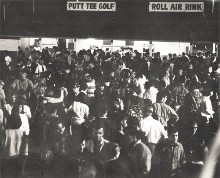 The Roll Air shuffle
With the help of plenty of on-air advertisements from Dyer and Fabian on WKNX, the Battle of the Bands became an instant sensation, and Roll-Air was soon the hottest spot in the area for young people to go on Tuesday nights. The teens would dance, talk, watch the bands, and move in a continuous rotation around the rink that became known as the ‘Roll Air shuffle.’ The weekly battles also provided a wonderful opportunity for young bands to get up on stage in front of their peers and display their skills.
The first Battle of the Bands at Roll Air took place on Tuesday, June 30th. Admission was 75 cents. The Del Raes, a popular band from Bay City and Essexville, came in first place. The Del Raes defended their position for the rest of the summer to become the first champions of Roll Air’s Battle of the Bands.
The Bay City Times reported that 16,000 young people attended the eight performances over the summer that featured twenty different bands competing for the $1,000 in prize money: 1st place - $600, 2nd place - $250, and 3rd place - $150.
The success of the Battle of the Bands at Roll Air along with WKNX’s savvy decision to concentrate on programming the sounds of The Beatles and other English acts led to Dyer and Fabian becoming local celebrities, and WKNX being rated the # 1 radio station in mid-Michigan during the 1960s. 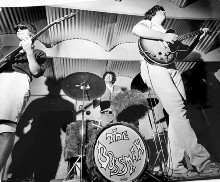 The Bossmen at Roll Air
As the battles grew more popular, the rink itself seemed to grow with them. Additions were built, stages expanded, as Roll Air stretched to contain the sound and the crowds. To make things even more exciting, Roll Air began booking popular Michigan bands like The Bossmen, and Terry Knight and the Pack to perform as special guests on Tuesday nights.
Dan and Ed Gavrila worked at Roll Air and Putt Tee alongside their parents and the Darbees during the summers. Their jobs included sweeping up, cleaning the bathrooms, and removing gum from the floor, taking tickets, handing out rental skates, making popcorn, and selling candy bars.
Roll Air’s Battle of the Bands continued to be a major event each summer, but Bob Dyer and Dick Fabian eventually moved on. Their reasons were a mixture of timing, changing music, and lives that constantly looked for new challenges.
Their partnership with the Darbees and Gavrilas at Roll Air ran for three years; and then Dyer and Fabian came up with the idea of establishing their own successful teen nightspot by renting the Y.M.C.A. gymnasium in Saginaw on Saturdays nights. Called the Y A-Go-Go, it featured local bands along with performances from national recording artists including Simon & Garfunkel and Glen Campbell.
In 1968, the Giffel family sold Tony’s Park to the Gavrilas and the Darbees. The following year the amusement park would play a part in what became the biggest rock and roll event in Bay City during the 1960s.
According to the Bay City Times' article ‘Pop Festival Draws Thousands’, three organizations – Tony’s Amusement Park, WKNX Radio, and Mike Quatro Inc. – collaborated to bring an estimated 4,000 music lovers to the Roll-Air outdoor roller rink on August 26, 1969, for a day-long show that featured some of the state’s finest bands. The article went on to reveal that Bob Darbee and Octavian Gavrila organized the operation, Mike Quatro Inc. provided the entertainment, and Bob Dyer and WKNX added the publicity and co-sponsored the event. 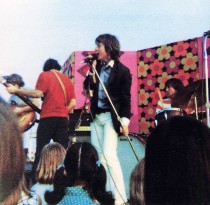 The Rationals at Roll Air 1969
The “1st Michigan Pop Festival” in Bay City was scheduled less than two weeks after the nationally acclaimed Woodstock Music & Art Fair held at Max Yasgur’s 600-acre dairy farm, near the town of Bethel, New York. The stellar list of bands that performed that day at Roll Air included the Bob Seger System, SRC, The Frost, The Rationals, Frijid Pink, and The Unrelated Segments. Also appearing were The Pleasure Seekers, an all-girl band featuring Suzi Quatro, and The Popcorn Blizzard with Meat Loaf as its lead singer. Although MC5 was listed as the headliner, the band did not appear due to a scheduling conflict.
The MC5 made up for their absence when they appeared as the special guest artist at Roll Air’s first Battle of the Bands in 1970. Plans were already in motion to hold a second all day rock festival in August, but despite the success of the previous summer’s festival the event was not destined to have a long life.
The following year’s festival was scheduled for August 18, 1970, but a few things had changed from the previous year. The name ‘Michigan Pop Festival’ had been jettisoned, and the flyer for the event advertised it as the ‘Super Tuesday – Outdoor Rock-Amusement Festival’. The event now boasted two stages and promised 9 hours of non-stop rock & roll from 3 p.m. until midnight, with tickets costing $4.00 in advance or $5.00 at the door. The headliners were announced as The Frost, along with SRC, Teegarden & Van Winkle, the Bob Seger System, and The Amboy Dukes. The undercard listed Ormandy, 3rd Power, Brownsville Station, the John Drake Shakedown, and Suite Charity. 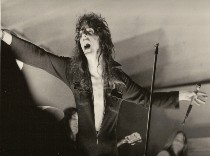 Alice Cooper at Roll Air 1970
The most interesting act, not even listed on the flyer, was a little-known band with the unusual name of Alice Cooper that had recently relocated to Michigan from California. Luckily, the Bay City Times was at Roll Air when Alice Cooper took the stage and a photo of the band’s lead singer appeared in the next day’s issue of the newspaper.
The Super Tuesday festival was a financial disaster, however, primarily because of the weather. Thunderstorms moved through the night before, and rain continued through most of the following day. Because Roll Air had no roof and seating was only available on the rink’s wet surface, conditions were uncomfortable for attendees. Although more than 3,000 people were expected, only about 1,000 braved the rain and paid admission. Many others stayed outside the gates and listened for free, adding to the event’s financial losses.
Bob Darbee told the Bay City Times that a large sum of money had been lost, and that the Super Tuesday extravaganza would be the last such event they would have at Roll Air. “We’re going to have to come up with something different for next year,” he said. “You can’t have big name entertainment like this without paying big money and to do that, you need big crowds.”
As the 1970s wore on, Roll Air fell victim to the bigger concert venues, larger festivals, and financial challenges as rock and roll became a big business. They combined to mark the end of the venue’s most successful period of teen dances and live music.
The Darbees ended the partnership with the Gavrilas in 1976 when they sold them their shares of Roll Air/Putt Tee and Tony’s Park. The Gavrilas continued to run Tony’s Park until they sold it to Mussell Beach Amusements in 1984; but they went out of business in 1990, and the park reverted to the Gavrilas. The carousel was eventually purchased by Deer Acres and some of the other rides by the Bay County Fair Association.  Chickadee Nature Trail
That same year, the Gavrilas sold the Roll Air and Putt Tee property to the State of Michigan. The structures on State Park Drive remained until they were demolished sometime before 1998. The Department of Natural Resources now owns and manages the property, and the former Roll Air site is encircled by the Chickadee Nature Trail, an area of tall grass and trees with a paved walkway for viewing wildlife.
That walkway might bring memories that glow warmly for some visitors: the tall neon sign for Roll Air and Putt Tee, the long lines of excited teens, the many bands that played there, the roar of the crowds and the silence at night's end. And even after those reminiscences drift away, there is always the sense that Roll Air held stories left untold, echoing softly through the long grass where the iconic skating rink once stood.
.