Jack and Devora Brown founded Fortune Records, one of Detroit’s first successful independent record labels. Operating from 1946 to 1995, Fortune also had three subsidiary labels, Hi-Q, Strate-8, and Renown Records. The company was a family affair, as Devora wrote many of the songs that appeared on the labels and Jack recorded the songs. It is estimated that Fortune Records and its subsidiaries released approximately 400 recordings, mostly singles.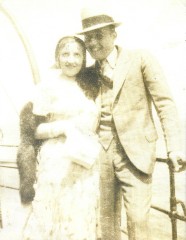 Devora and Jack 1930s.
Fortune specialized in R&B, blues, soul, doo-wop, and hillbilly music; but the label also released pop, big band, rockabilly, gospel, rock 'n' roll, and polka records. Over the years, the Brown’s recorded a litany of important artists including John Lee Hooker, Andre Williams, Eddie Kirkland, Doctor Ross, the Davis Sisters, Kenny Burrell, the 5 Dollars, Nathaniel Mayer, Skeets MacDonald, Johnny Powers, and Nolan Strong and the Diablos.
Not much is known personally about Jack and Devora Brown other than she was an aspiring songwriter/lyrist and Jack, after receiving an accounting degree from Wayne University, became an accountant. Both were born in 1910, and they lived at the Jewish 12th Street Community with a home at 11829 12th Street, now known as Rosa Parks Boulevard. They had two children, Sheldon and Janice who both later worked at Fortune.
The Fortune Record story really begins with composer-lyricist Devora Brown who, in the early 1940s, had written and published (in sheet music) many of her early songs. Originally from Cleveland, Devora had first met Jack on a blind date. An aspiring songwriter and pianist, Devora was looking to have her songs published.
The Browns would make several unsuccessful trips to Manhattan trying to break into Tin Pan Alley. Failing to find interest there, they decided to establish their own record company with the goal of recording Devora's songs. Jack always said that they could make a fortune with Devora's songs; and in the fall of 1946 the couple invested $300 and named the company Fortune Records. 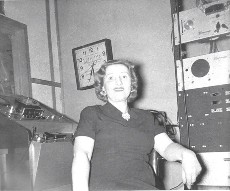 Devora in the Fortune studio
They hired Artie Fields' sixteen-piece orchestra, featuring Canadian singer Russ Titus, to record two of Devora’s compositions, “Jane (Sweet As Summer Rain)” and “Texas Tess Down Texas Way” at the studios of Vogue Records in Detroit. When the record failed to create any interest among the major labels, they decided to put it out themselves as Fortune 101.
This first attempt made them realize that it was too expensive to record pop songs with an orchestra, and they shifted toward blues and hillbilly music. After first operating out of their home, they soon opened their own studio at 11629 Linwood Avenue in Detroit.
Detroit was transformed by the automobile industry, and people migrated to the Motor City from all over the country to take advantage of its economic opportunities offered by the higher paying jobs in the auto plants and related industries. Many of these newcomers brought their music with them. As a result, the Motor City was teeming with talent, and the Browns’ open-door policy of recording took full advantage.
In early 1948, Jack dropped off some records at a store on Lafayette Street. The owner was acting as John Lee Hooker’s manager. Jack took Hooker to Toledo when he couldn’t get a studio in Detroit, and he cut the first record in the legendary musician’s career.
It wouldn’t be his first official release, however, because Jack didn’t think that “Sadie Mae,” Hooker’s song about a guy pleading to a hairdresser to curl his baby’s hair, was that good and held off on pressing it. Later that year, Hooker jumped to Bernie Bessman’s rival record store on Woodward, where his recording of “Boogie Chillen’” was leased to Modern Records and became a # 1 R&B hit in 1949.
Although they missed out on John Lee Hooker, Fortune’s blues roster drew other talent from the wide-open Hastings Street black entertainment thoroughfare in Detroit including Big Maceo Merriweather, Grace Brim, Bobo Jenkins, and Chet Oliver. 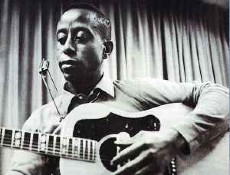 Doctor Ross
One of Fortune’s most interesting blues artists was Isaiah Ross, best known as Doctor Ross 'The Harmonica Boss.' His early recordings in the 1950s were produced by Sam Phillips at his Sun Studio in Memphis. In 1954, Ross moved his family to Flint, Michigan, and began working at a General Motors plant.
Doctor Ross usually performed as a one-man band, simultaneously singing and playing guitar, harmonica, and drums. Ross joined the Fortune roster in 1959, and his recording of “Cat Squirrel” later brought him to the attention of rock audiences when the song was covered on the debut albums of both Cream and Jethro Tull.
Jack and Devora knew very little about black vocal group harmony until they met a young man named Nolan Strong who had formed the Diablos at nearby Detroit Central High and wanted to record a demo. The Browns were impressed with Strong's high tenor and signed the Diablos to a recording contract. In the spring of 1954, the group recorded "Adios My Desert Love", a song written by Devora Brown, and it became a big Detroit R&B hit.
In August, the Diablos returned to Fortune and recorded their self-penned masterpiece, "The Wind.” Nolan Strong's silky falsetto evoked memories of a lost love that were brought back like a dream by the wind. Released in September of 1954 as 'The Diablos featuring Nolan Strong,' "The Wind" became not only a huge R&B hit in Detroit, but also in other important markets including Chicago, Cleveland, Pittsburgh, and New York. Sadly, Fortune's spotty distribution prevented the classic recording from reaching the national R&B charts.
Nolan Strong and the Diablos would record over two dozen singles for Fortune and help make harmony groups a mainstay of the label. The Diablos were soon joined by the Centurys, the Swans, the Gardenias, the Delteens, the Montclairs, and the Royal Jokers. The youngsters would come over after school, and the Browns would record them.
It was the Browns’ working relationship that kept Fortune on course. Jack engineered the vocal group sessions with a minimum of microphones, physically moving instruments like the piano around the room to get a one-track balance, his only effect a variable tape echo. It produced a live sound with drums and guitars scattering off the cinder block walls; the singers in tight, with no headphones.
Devora would be out in the studio, working with the groups, fine tuning the harmonies, helping with the lyrics and onomatopoeia, becoming one of the first female producers. It was a record company in which Jack and Devora were very hands-on and ran the operation themselves. They booked the singers and bands, and promoted them in the field. They also got on the phone with the pressing plant, paid off the disc jockeys, and did the mail orders.
Fortune released 11 singles by Andre Williams. Devora signed Andre to a recording contract after witnessing one of his over-the-top performances an amateur show at the Warfield Theater on Hastings Street. She invited Williams to join a Fortune vocal group called the Five Dollars who had recently lost a member to the draft.
Andre’s flamboyant dancing and wild stage antics soon made him the group’s front man. Knowing that he didn’t possess a pleasing tenor voice like that of the immensely popular Clyde McPhatter or his Fortune label mate Nolan Strong, Williams came up with the gimmick of talking in rhythm rather than singing. 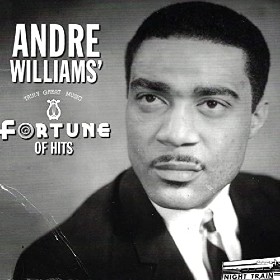
In 1956, Williams scored his biggest hit with “Bacon Fat,” a song he co-wrote with Devora Brown. It reached # 9 on the Billboard R&B chart after it was licensed to Epic Records. Williams’s singing style is often cited as an early example of hip-hop vocalizing; and he used the same approach on subsequent releases that included “Jail Bait,” his sly ode to the dangers of getting involved with an underage girl.
Fortune’s last big R&B artist was Nathaniel Mayer. By this time, Jack and Devora had moved their label to a narrow brick building at 3942 Third Avenue. Mayer first visited Fortune to inquire about making a record of some of the song ideas he had written down. Not knowing what to do with a precocious 12-year-old, the Browns shuffled him off to Joe Weaver, leader of the Blue Notes, Fortune’s house band. Serving as something of a music teacher, Weaver showed young Mayer how to structure his writings into songs.
Mayer started performing at sock hops in high school, and he made his first important appearance in 1959 at DJ “Frantic” Ernie Durham’s record hop at the Graystone Ballroom on Woodward Avenue. Mayer signed with Fortune not long after, and he recorded his first single, “My Last Dance With You” backed with “My Little Darling,” at the tender age of 16.
Nathaniel Mayer will be best remembered, however, for his second Fortune single and signature hit from 1962, “Village Of Love.” Author David Carson described Mayer’s song in his book, Grit, Noise & Revolution: “It was the rawest of recordings and an instant Detroit classic. As Mayer shouted, screamed, and wailed, the ‘Village Of Love’ didn’t sound like a very romantic place.”
“Village Of Love” was an instant smash. It was selling so fast in Detroit that the Browns decided to accept an offer to lease it to United Artists for better national distribution. The move paid off, with the record reaching # 16 on the Billboard R&B chart and # 22 on the Billboard Hot 100. “Village Of Love” was an even bigger hit on Cash Box, spending 15 weeks on that chart and peaking at # 10.
The Browns had struggled to meet the demand for records, however, and were only accounted 180,000 records on what must have been close to a million seller. Feeling they had been cheated, they stopped leasing their singles, and Nathaniel Mayer was never able to follow up his big hit.
Jack and Devora’s studio also attracted the white hillbilly and country bop artists from the sharecropping areas in rural South and the mining communities of the Appalachian Highlands who were looking for a better way of life in the auto plants. They brought their love of the music to Detroit, and it thrived in clubs and taverns that catered to those workers and musicians.
The Browns took advantage of the localized hillbilly market early on when they reissued the York Brothers’ “Hamtramck Mama” and "Highland Park Girl." Fortune scored other adult ‘party record’ hits on Motor City jukeboxes, including Skeets McDonald’s “The Tattooed Lady,” Roy Hall’s “Dirty Boogie,” and a pair of suggestive releases by Johnny Buckett – “Griddle Greasin’ Daddy” and “Let Me Play With Your Poodle.”
They also recorded Skeeter Davis’s first hit single, “Jealous Love,” while she was performing as one half of the Davis Sisters. Devora paid the girls $25 to record a demo with Roy Hall on piano, then released the result as a single in 1952. Its success led to the Davis Sisters signing with RCA Records. Skeeter Davis later moved to Nashville and became one of the first solo female stars in country music.
The national success of the early Sun Records of Elvis Presley and Carl Perkins saw a rise in popularity of rockabilly, and Fortune was quick to hop on the bandwagon with “Hey, Mr. Presley” by Jimmy Franklin, “Rock ‘n’ Roll Grandpap” by Don Rader, “Humpty Dumpty” by Al Burnette and His Southern Swingsters, “Rock The Universe” by Dell Vaughn, and “I’m Sheddin’ Tears” by Shorty Frog and His Space Cats.
Fortune’s best bet for producing a rock and roll star might have been Johnny Powers. Born John Pavlik, he started playing country music at 15, but quickly switched to rockabilly and found his way to Fortune to make his first recording. Devora gave him his ‘Powers’ stage name after seeing him eat a Powerhouse candy bar in the studio before recording “Honey Let’s Go (To A Rock and Roll Show).”
It would be Powers’ only Fortune release, however, as he moved on to Fox Records in Detroit and then Sun Records in Memphis. In the 1960s, Johnny Powers signed with Motown. It made him the only artist in history to record with Fortune, Sun, and Motown.
By the Fortune label’s 20th anniversary, the record industry had become much more sophisticated and many radio stations had adopted the National Top 40 format. The types of independent recordings made at Fortune struggled to get airplay, and the market for the company's records dwindled as a result.
1973 brought tragedy when Jack and Devora were struck by a car while crossing the street. Jack, seriously crippled, would never fully recover, and he passed away in 1980. Devora tried to carry on the business with her children, but she received another major blow when her daughter Janice died of cancer in 1981. Janice had tried to infuse new life in the business by reissuing old Fortune albums with modern artwork. 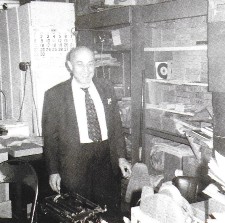 Jack Brown at Fortune
Devora passed on in 1996, the 50th anniversary of the founding of Fortune Records. Sadly, she spent her last years confined to a nursing home while suffering from dementia.
Jack and Devora Brown were inducted into the Michigan Rock and Roll Legends Hall of Fame in 2025.
Main Sources:
Mind Over Matter: The Myths and Mysteries of Detroit’s Fortune Records by Billy Miller and Michael Hurtt. Forward by Lenny Kaye.
Grit, Noise and Revolution by David A. Carson
History of Rock Website: Fortune Records
Dirty Boogie: The Fortune Records Story, Liner notes by Mick St. Michael